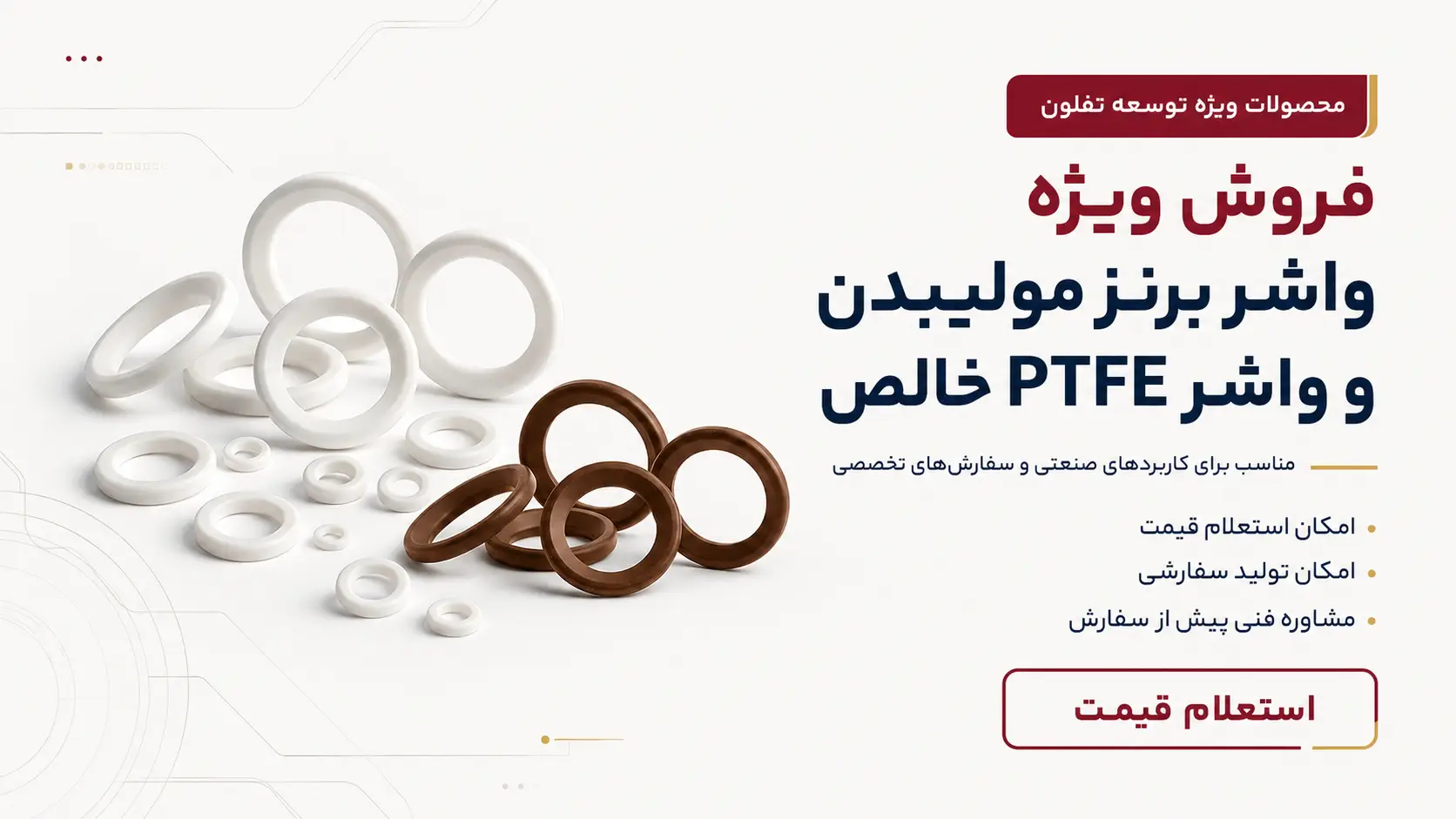
Virgin PTFE
Order Virgin PTFE GasketContact Us: +989125159567
For pricing and order placement, please provide the flange dimensions, process media, operating temperature and pressure. Our technical team will recommend the optimal size, thickness and grade of virgin PTFE gasket for your application. Custom and standard dimensions are available upon request.

Virgin PTFE Gasket (100% Teflon) | The Preferred Sealing Solution for Chemical and Hygienic Environments
The Virgin PTFE gasket is a 100% Teflon industrial gasket offering maximum chemical resistance and high purity. It is widely used for sealing flanges in chemical, food, and pharmaceutical industries. If you need a PTFE gasket that delivers stable performance at high temperatures and under exposure to aggressive acids and bases, the virgin grade is the ideal choice.
For pricing and technical selection, our engineering team can assist you in choosing the proper gasket size according to your fluid, pressure, and temperature requirements.


A Virgin PTFE gasket is not merely a simple Teflon ring—it is engineered for applications where long-term stability, fluid purity, and consistent performance are critical. Due to the molecular structure of PTFE, the gasket remains highly resistant to most acids, bases, oxidizers, and organic solvents, even under prolonged exposure. This makes virgin PTFE the default choice in process systems where leakage or downtime can be costly or hazardous.
Compared to reinforced PTFE grades, the virgin version offers lower mechanical strength but the highest chemical resistance and purity. Its stable and predictable behavior under long-term exposure makes it highly preferred in food, pharmaceutical, specialty chemical, and hygienic applications. With proper gasket thickness, flange selection, and bolt torque, virgin PTFE provides an excellent balance of sealing reliability, service life, and cost-effectiveness.
Key Technical Specifications of Virgin PTFE Gaskets (100% Teflon)
- Base Material: Virgin PTFE (Polytetrafluoroethylene)
- Filler Type: None (Unfilled)
- Recommended Operating Temperature: approx. –200°C to +260°C (depending on flange design and bolt torque)
- Creep Behavior & Dimensional Stability: Acceptable at medium pressures; reinforced grades are recommended for high-pressure applications.
- Color: White (Off-white) — suitable for hygienic environments and easy visual inspection.
- Machinability: Suitable for precision cutting and machining in both standard and custom dimensions.
- Chemical Resistance: Excellent against most acids, bases, organic solvents, and corrosive fluids.
- Wear Resistance: Moderate — best for static applications; reinforced grades are recommended for high-wear scenarios.
- Coefficient of Friction: Approx. 0.10–0.04 (one of the lowest among solid materials)
- Surface Properties: Non-stick, smooth, and low friction; minimal adhesion to metals and fluids.
- Recommended Applications: Sealing flanges and fittings in chemical, food, pharmaceutical, and high-purity process systems where chemical resistance is essential.
Advantages and Limitations of Virgin PTFE Gaskets (100% Teflon)
Before selecting a virgin PTFE gasket, it is important to understand where this grade performs best and where reinforced PTFE options offer better mechanical stability. Virgin PTFE provides the highest chemical resistance and purity among PTFE gasket types, but it may not be the best choice for high mechanical loads. Knowing these advantages and limitations ensures reliable sealing performance and helps evaluate cost, service life, and operational downtime more accurately.
Advantages of Virgin PTFE Gaskets
Limitations of Virgin PTFE Gaskets
When Is Virgin PTFE the Optimal Choice?
| Operating Conditions / Scenario | Suitability of Virgin PTFE Gasket | Recommended Alternative Grades | Additional Notes for Selection |
|---|---|---|---|
| Highly Corrosive Environments Requiring High Purity (Food, Pharmaceutical, Fine Chemical) | Primary recommended choice | Alternative (for slightly higher pressure): 25% Glass-Filled PTFE | In such applications, maximum chemical resistance and fluid purity are the top priorities—making virgin PTFE the preferred sealing material. |
| Moderate Pressure and Temperature with Corrosive Fluids (General Process Lines) | Fully suitable and cost-effective | 25% Carbon-Filled PTFE or 25% Glass-Filled PTFE (if higher strength is required) | If bolt load and flange pressure remain within normal limits, virgin PTFE is both cost-efficient and technically reliable. |
| High Operating Pressure or High Bolt Torque | Use with caution (suitable only for mid-range pressures) | 25% Carbon-Filled PTFE, 40% Bronze-Filled PTFE, or 25% Glass-Filled PTFE | Under high loads, virgin PTFE is prone to creep; reinforced grades are recommended for better mechanical stability. |
| Severe Wear, Dynamic Motion, Vibration, and Continuous Sliding | Not recommended | Bronze + MoS₂ / Carbon-Fiber + MoS₂ | |
| Near-Maximum PTFE Temperature (≈260°C) with High Mechanical Load | Limited; narrow safety margin | PEEK-based gaskets or high-temperature composites | If both high temperature and mechanical load are present, virgin PTFE is not recommended. |
| Hygienic Systems with Frequent CIP/SIP Cleaning and Easy-Clean Requirements | Highly suitable | Glass-filled PTFE recommended where additional strength is needed | Non-stick surface, neutral taste/odor, and stability under cleaning cycles make virgin PTFE ideal for sanitary systems. |
| Budget-Constrained Applications with Moderate Technical Requirements | Sometimes over-specified | Economical PTFE grades or alternative sealing materials | For low-risk, low-pressure applications, virgin PTFE may exceed requirements. |
| Custom Gasket Requirements with Special Dimensions for Highly Corrosive Media | Excellent choice | Glass-filled or carbon-filled PTFE for higher loads | Custom virgin PTFE gaskets perform well in corrosive media; reinforced grades can be used when mechanical stress increases. |
Recommended Industries & Applications for Virgin PTFE Gaskets
Virgin PTFE gaskets, due to their exceptional chemical resistance, high purity, and non-stick surface, are used in industries where leakage, fluid contamination, or gasket degradation can be costly or hazardous. In many critical process lines, virgin PTFE is the primary sealing choice for static flange connections—especially where corrosive media, elevated temperatures, and stringent sanitary requirements are present.
Below are the key industries and applications where virgin PTFE gaskets are most commonly recommended.
Chemical processing and corrosive media handling
In chemical processing units handling strong acids, bases, aggressive solvents, and corrosive media, virgin PTFE gaskets are a reliable sealing choice due to their complete chemical inertness and exceptional corrosion resistance. They provide secure static flange sealing and help prevent leakage and premature corrosion.
Food and beverage production lines requiring purity and non-contamination
In food and beverage processing lines where product purity, non-contamination, and easy cleaning are essential, virgin PTFE gaskets are an ideal choice. Their non-stick surface and chemical inertness make them suitable for sealing stainless-steel flanges, tanks, and pipelines.
Pharmaceutical and biotechnology systems with stringent hygienic requirements
In food and beverage processing lines where product purity, non-contamination, and easy cleaning are essential, virgin PTFE gaskets are an ideal choice. Their non-stick surface and chemical inertness make them suitable for sealing stainless-steel flanges, tanks, and pipelines.
Specialty chemical and solvent manufacturing
In facilities producing virgin organic solvents, fine chemicals, or highly sensitive process fluids, virgin PTFE gaskets help minimize unwanted reactions between the gasket and the media, ensuring product purity—especially under elevated temperatures and prolonged exposure.
Laboratory and pilot-scale equipment exposed to diverse chemicals
In laboratory and pilot-scale systems—where process media frequently change and a wide range of tests are performed—using a virgin PTFE gasket ensures broad chemical compatibility and helps protect equipment against diverse chemical exposures. This significantly reduces the need for frequent gasket replacement and maintains stable sealing performance over multiple operating cycles.
Sanitary process lines with frequent CIP/SIP cleaning cycles
ginIn systems routinely cleaned with steam, detergents, and sanitizing solutions, virgin PTFE gaskets offer reliable sealing due to their resistance to cleaning agents, stability under hot steam, and smooth non-stick surface—making them a dependable choice for maintaining hygienic standards.
Frequently Asked Questions About Virgin PTFE Gaskets
Pure PTFE contains no fillers such as carbon, bronze, or glass. It offers maximum chemical resistance and purity, making it ideal for aggressive acids, bases, and solvents. Filled PTFE grades provide higher mechanical strength and pressure tolerance but sacrifice a small amount of chemical resistance.
A virgin PTFE gasket is generally the optimal choice when maximum chemical resistance, media purity, and strict hygiene requirements are the primary criteria.
This grade is widely used in:
Food and beverage processing lines
Pharmaceutical and biotech systems
Fine chemical production
High-purity solvent and reagent lines
Sterile or sanitary environments
Virgin PTFE performs exceptionally well in moderate-pressure static flange joints, provided that the flange design, bolt loading and tightening procedures are correctly implemented.
When selecting a virgin PTFE gasket, simply specifying the process fluid, temperature, and operating pressure is typically sufficient to validate whether the application falls within the safe operating window for this material.
Virgin PTFE offers excellent sealing performance in low- to medium-pressure applications; however, under high internal pressure or excessive bolt torque, the material is prone to creep and cold flow, which can gradually reduce gasket stress and compromise long-term sealing integrity.
For sustained high-pressure service, the following reinforced PTFE grades are generally recommended:
Carbon-filled PTFE
25% glass-filled PTFE
40% bronze-filled PTFE
These grades provide significantly improved mechanical strength, reduced creep, and better load-bearing performance compared to virgin PTFE.
Therefore, for high-pressure duty, always consult the technical team to confirm suitability before selecting a virgin PTFE gasket.
Yes. Virgin PTFE is one of the most widely used gasket materials in food, beverage, pharmaceutical, and biotech processing.
Because the material is chemically inert, it:
does not absorb or transfer taste or odor,
has a naturally non-stick, low-friction surface,
withstands repeated exposure to steam and aggressive cleaning agents used in CIP/SIP cycles,
provides stable long-term sealing without contaminating the process media.
Whenever a process line involves aggressive chemicals + strict hygienic requirements, virgin PTFE is typically the first gasket grade recommended.
(greater OD/ID and thicker sections require more material and machining time)
(simple flat ring gaskets are less expensive than complex, tight-tolerance geometries)
(single-piece or small-batch production typically has a higher unit cost compared to series or bulk manufacturing)
(traceability documents, inspection certificates, custom packaging, etc.)